"Sometimes you wish you could just throw paint at the wall and have it turn out beautiful — because that's genuinely all the time you have for any one task."
We get it. You're wearing all the hats. You need stuff to work the first time, every time. The clock doesn't stop while you figure out a new tool, wrangle a subscription, or explain your whole business to an AI that forgot it by morning.
We understand — because we're a single-person small business operation too. Not a software company. Not a funded startup. One person, the same tools you have, the same clock running.
So we engineered the system to save you time, every time. The briefing happens once and stays locked in forever — every project, every job, from here on out. The tools are built for minimum finagling and maximum customization, each one producing exactly the output the next tool is expecting. That's engineering the workflow so you don't have to.
You worry about being the pro in your business. We'll worry about the engineering to make you look like the AI pro in the room.
If you can explain what you do to a neighbor over a split rail fence, you can run this system.
Intake. Claude learns your business.
You drop the Transfer Document into a new Claude Project and let it run. It loads the intake process, asks the right questions, and structures everything Claude needs.
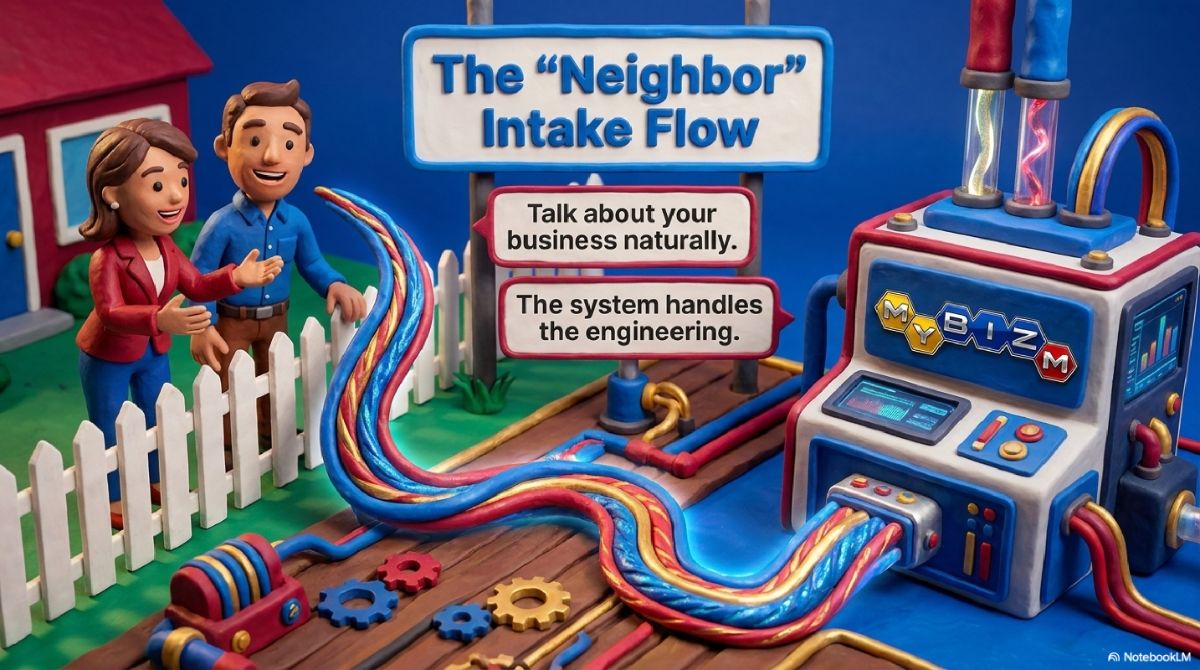
Claude reads your website directly during the session — grounding everything in your public reality, not just what you tell it. The Pre-Work Worksheet gets you ready before you open the screen. Pen and paper. Coffee. Away from the distractions. By the time you sit down with Claude, you know exactly what you want to say. The session flows fast.
Transfer Document
The intake engine. Drop it in. It loads the process, asks the right questions, structures everything Claude needs to build your brand documents.
Pre-Work Worksheet
Pen and paper before the screen. Fill it out over a coffee. By the time you open Claude, you know exactly what to say. No fumbling. No starting over.
Website Read
Claude reads your site directly during intake. Grounds the session in your public reality — not just what you tell it, but what you've already told the world.
60–90 Minutes
That's the setup window. Free Claude users work in 2–3 sessions inside the same Project. It picks up exactly where it left off.
Build. Five brand documents. Automatically.
This is what most businesses never have. A complete, structured brand intelligence system — not a style guide, not a mood board. Five working documents that two AI systems will use as their permanent reference library.
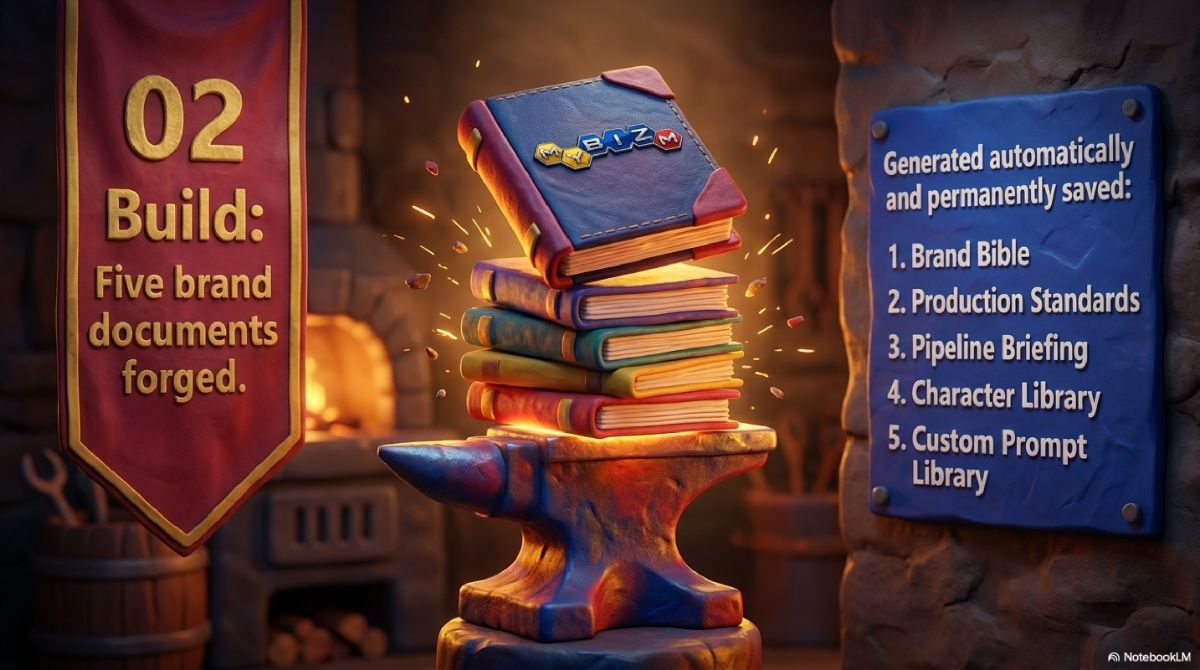
Most agencies charge thousands for a fraction of this. You get all five, generated in your session, built entirely from what you know about your own business.
- DOC 01Brand Bible
Your complete brand identity. Voice, tone, positioning, values, differentiators. The authoritative source for every piece of content that follows.
- DOC 02Production Standards Guide
Platform specs, content format rules, image standards, video requirements. Every output specification your production workflow needs.
- DOC 03Pipeline Briefing Document
The briefing that loads into NotebookLM. Structured specifically for AI content generation — optimized to get your visual language into every slide deck, every infographic, every video.
- DOC 04Character Library
For businesses with brand characters — complete character briefs, visual descriptions, personality notes, usage guidelines. Fully supported and built into the system.
- DOC 05Custom Prompt Library
Prompts engineered specifically for your brand's aesthetic. They only work for you. Generated from your intake session — this is what makes your output irreplicable.
Produce. NotebookLM generates in your visual language.
Load your five brand documents plus your website into Google NotebookLM. Fire the prompts from your Custom Prompt Library. NotebookLM generates content in your brand's visual language — not a generic template. Yours.
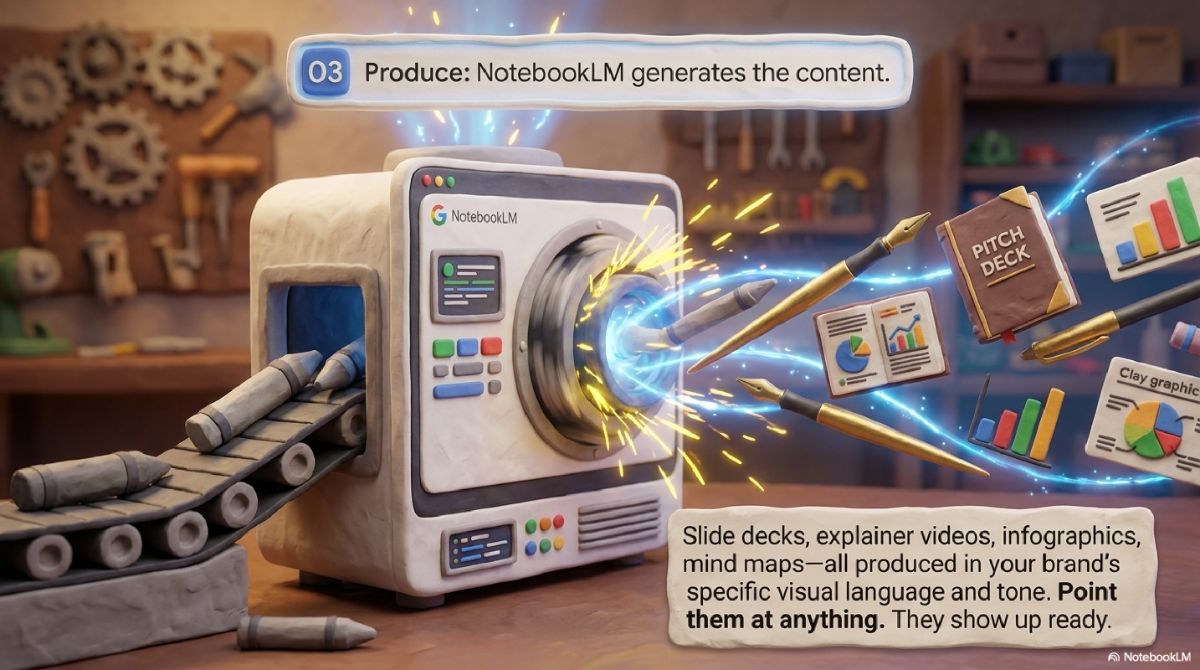
Output is 16:9 format — ready for X, Facebook, LinkedIn, and Instagram. Every deck, every infographic, every mind map already sized for the platforms you use.
Slide Decks
16:9 multi-slide presentations in your brand aesthetic. Ready for the production tools.
Deep Dive Audio
AI-generated audio exploration in your brand's context. NotebookLM's native format at its best.
Explainer Videos
Visual + narrated explainer content built around your brand's key messages.
Infographics
Data and concept visualization in your brand's visual system. Scannable, shareable, on-brand.
Mind Maps
Visual topic mapping generated directly from your brand content library.
Deploy. Claude builds your social strategy.
Bring your NotebookLM assets back to Claude. Your Project already knows your business completely. It reviews the asset library, catalogs everything, and builds a complete social media calendar around the actual content you just produced.
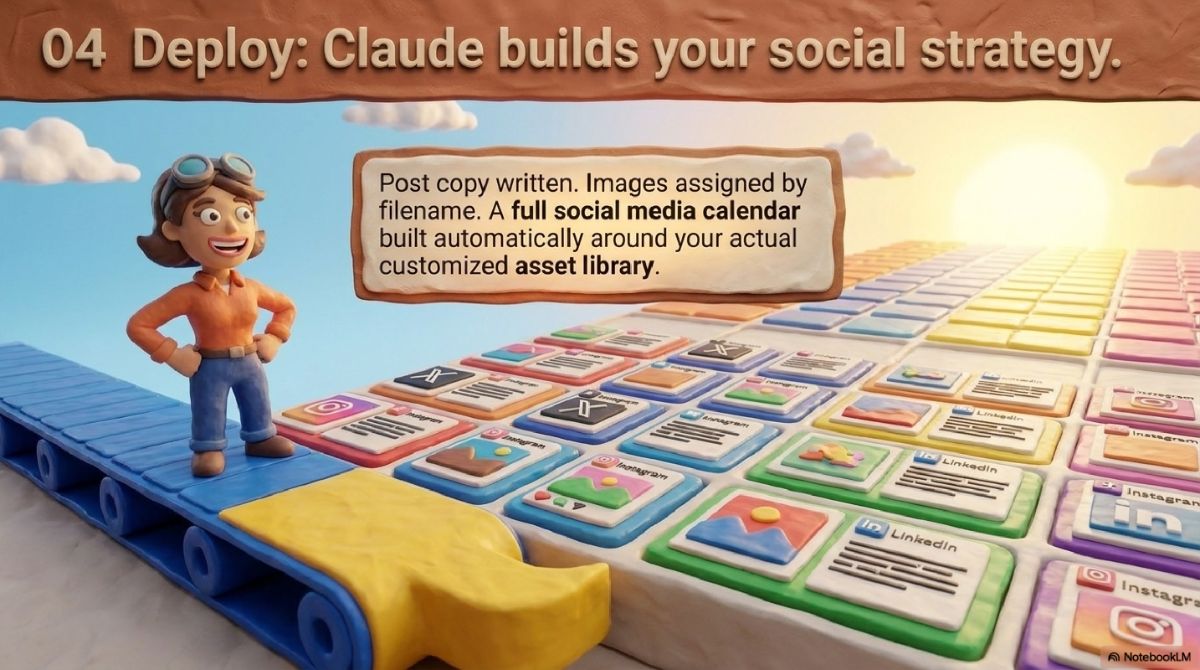
Post copy written. Images assigned by filename. Content scheduled across platforms. Built around what you actually have — in the voice your business actually uses.
Asset Catalog
Claude reviews and organizes everything NotebookLM generated. Every piece named, described, and ready for scheduling.
Post Copy Written
Platform-specific captions, hooks, hashtags — written in your brand voice, for your audience, around your actual assets.
Images Assigned
Every post paired with the right image by filename. Drag-and-drop ready for your scheduling tool of choice.
Calendar Built
Full social media calendar — not a template. Built from your real asset library, in your production cadence.
The calendar is what you see.
The collaborators are what you keep.
A social media calendar is what most people expect to leave with. That's the surface. Underneath it are two AI systems that know your business completely — ready for anything you point them at, from now on.
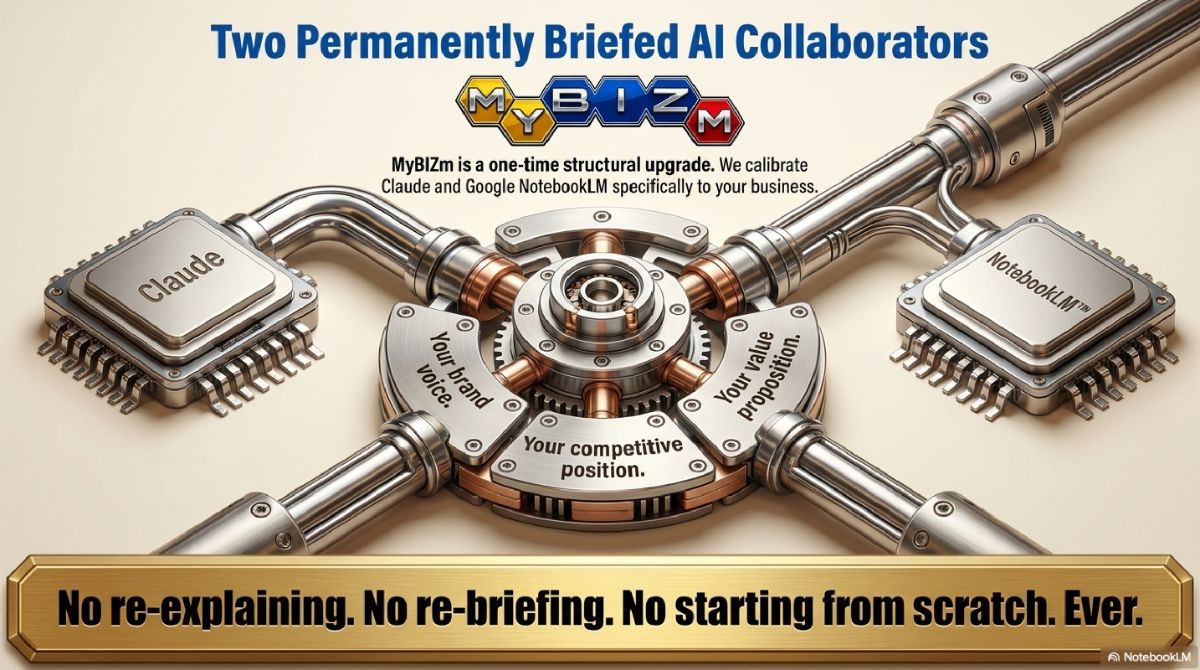
The consultant who knows your business this deeply bills $150 an hour — and goes home at five. Your briefed AI collaborators don't.
No starting from scratch. Ever.
your bizm?
Four steps. One session. Two permanently briefed AI collaborators — plus 14 purpose-built production tools. Everything runs in your browser. Nothing leaves your machine.
Get MyBIZm — $297 →